A Carfax (or AutoCheck, or vHist, or any vehicle-history report, they all work the same way) is the single most-misread document in the used-car market. Most buyers either skim it, see "no accidents reported," and move on – or stare at the whole thing trying to make every line item meaningful. Both are wrong. There are exactly five fields you should be reading, four you should be skipping, and one most buyers never even open.
This is what I actually do when I run a history report on a candidate car for a client. It takes about four minutes per report once you know what you're looking for.
Why most people misread it
Carfax sells you a feeling, not a forensic record. The big green checkmarks ("No accidents reported!" "Single owner!") are designed to make you feel safe, and the company makes its money when you feel safe enough to buy. The actual signal lives in the boring black-and-white text below the badges, in the timestamps, the gaps, and the mismatched postal codes.
The trick is to read the report the way an underwriter reads a loan application: assume the document was prepared to make the car look good, and look for the fingerprints of what's not being said.
The five fields that matter
1. Title history (and the gaps in it)
This is the first thing to check. Specifically, you're looking at the chain of titled owners and the dates of each transfer. What you want to see is a clean linear progression, with consistent postal codes (or at least geographically plausible moves), and no gaps longer than a couple of weeks between owners.
What you don't want to see: a title that bounces between four provinces in a year, three transfers in 90 days, or a six-month period where the car appears to have lived on a flatbed. Each of those is a soft signal. Stack three of them and the report is telling you something.
If the title shows: Original owner → Insurance company → Auction → Dealer → Dealer → "Private seller", over the course of 8 months, you're looking at a totaled-out car that's been laundered through dealer channels back into the private market. I see this two or three times a month.
2. Odometer readings
Every reported event in the car's life – service, registration, inspection, transfer – usually carries an odometer reading. Carfax shows them in a column. Read down that column. The numbers should go up monotonically, and the rate of increase should be plausible.
Specifically: if the car shows 22,000 km in March, 30,000 km in May, and 26,000 km in August, you're looking at either a clerical error (rare) or an odometer rollback (common enough to check for). Even small rollbacks of 8,000–12,000 km are visible if you actually trace the column.
3. Damage / accident events with a "structural" tag
Carfax marks accidents one of three ways: minor damage, moderate damage, or "structural / frame damage." The first two are mostly noise, bumpers, fenders, doors, all of which can be repaired without affecting the car's long-term integrity. The third is a hard stop.
If a Carfax line item includes any reference to "structural damage," "frame damage," "airbag deployment," or "vehicle inoperable," the car is functionally a different car than it was before. Don't let anyone tell you otherwise. Check this field carefully, it's sometimes hidden in the third or fourth tab of the detailed view.
4. Service-record consistency
Cars get serviced. Cars that don't get serviced have a Carfax with three lines and a 50,000 km gap. Cars that get serviced at the dealer have neat, consistent records every 8,000–15,000 km, with descriptive service names.
What you're looking for: regular intervals, consistent location (or sensible relocations as the owner moves), and the major service items showing up at the right mileages, water-pump replacement around 90,000 km on a German car, transmission service at 100,000 km on most modern cars, etc. A car that has 18 oil changes and zero scheduled maintenance is a red flag in disguise.
5. Branded title / salvage flag
This is the field nobody talks about. In Canada, every province requires written-off, salvaged, or rebuilt vehicles to carry a title brand, assigned by the provincial registry (MTO in Ontario, SAAQ in Quebec, ICBC in BC, and so on) when an insurer or inspector deems the car non-roadworthy or repaired-from-write-off. Carfax Canada pulls these brands directly from provincial records and surfaces them as a single line item in the title-events column – easy to miss if you're not looking for it.
The brands to watch for: Salvage (insurer wrote it off, vehicle has not been re-certified for the road), Rebuilt (was Salvage, has since passed a structural inspection and been re-titled), Non-repairable or Irreparable (cannot legally return to the road – parts only), and in some provinces, Stolen-recovered. A Rebuilt brand is the one most people misjudge: it's legal to drive, but the brand stays on the title forever, insurance is harder to get and more expensive, and resale takes a 30–40% haircut. Walk on Salvage and Non-repairable outright. On Rebuilt, only if the discount reflects the lifelong tax – and even then, only if you're comfortable owning it long-term and disclosing the brand when you sell.
One more thing that surfaces in this column: manufacturer buybacks under CAMVAP (the Canadian Motor Vehicle Arbitration Plan, which handles new-vehicle defect disputes for participating brands). They're rare on Carfax, but when they appear, treat them the same way you'd treat any other manufacturer buyback – a flag that the car had a defect serious enough to be returned, even if it has since been "fixed."
The four fields you can ignore
Carfax pads the report with information that looks important but doesn't actually help you make a decision:
- Number of previous owners, in isolation. A two-owner car isn't automatically better than a four-owner car if one of those four was a leasing company that owned it for three months. Look at the title-history pattern, not the count.
- Carfax's own "value" estimate. They're guessing based on regional averages. Use Canadian Black Book or wholesale auction data instead, and for collector cars, comparable sales on Bring a Trailer or Cars & Bids.
- Reported recall information. It's there for completeness, but recalls are easy to verify with the manufacturer directly using the VIN (free, more accurate, more current).
- Vehicle inspection records, unless they show a failure. Provincial safety inspections (Safety Standards Certificate in Ontario, equivalents elsewhere) that the car passed are background noise. Inspections that the car failed and the seller hasn't disclosed, those matter.
The field nobody reads (but should)
Buried somewhere in every Carfax – usually in the second or third detail tab, is the full service-event log. Most buyers click straight to "Damage History" and never open this tab. They're missing the most useful field on the report.
The service-event log shows every reported service event, including dealer notes when available. This is where you find: open warranty repairs, recurring symptom patterns ("checked engine light, 4th visit"), accident-related repairs that didn't trip the damage flag, and service work that contradicts the seller's claims.
Specifically, look for:
- Repeated repairs of the same system. Three transmission service entries in 18 months means transmission trouble, regardless of what the seller says.
- Repairs on systems the seller claimed are "all good." If the listing says "no leaks, fully serviced" and the Carfax shows a head gasket service eight months ago – ask about it.
- The post-accident repair signature. Even non-flagged accidents leave service-record traces, wheel alignments, suspension work, electrical resets, clustered tightly in time. If you see five service events in two weeks followed by months of silence, something happened in those two weeks.
What to do with what you found
Reading the Carfax is the easy part. Acting on what you found is where most buyers fumble. Three rules:
Don't bring up Carfax findings until after the test drive. If you lead with concerns, the seller goes defensive and the price moves up, not down. Drive the car, like the car, then bring up the questions.
Translate every concern into a dollar amount. "I noticed there were three transmission services in 2024 – can you tell me what was going on?" is a question. "I noticed the transmission service history, and the local service rate for that work is $1,200, so my offer is $X," is a negotiation move. The first opens conversation; the second closes deals.
If the report shows hard-stop red flags (structural damage, Salvage or Non-repairable brand, airbag deployment), don't negotiate. Walk. No discount makes those problems go away. The car will still have those flags when you go to sell it, and it will still cost you on the back end.
When Carfax is wrong (and it is, sometimes)
A clean Carfax doesn't guarantee a clean car. Insurance-paid repairs below the carrier's reporting threshold (typically a couple of thousand dollars) don't appear. Self-paid repairs at independent shops mostly don't appear. Body work done before a sale, with the panels paid out of pocket to avoid an insurance claim, that doesn't appear either.
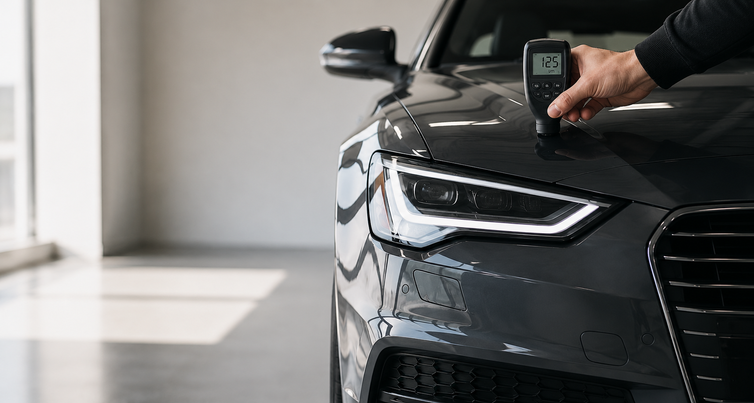
This is why Carfax is the start of due diligence, not the end of it. The actual physical inspection – paint depth gauges, panel-gap measurements, frame inspection, is what catches what the report misses. The Carfax tells you where to look first.
Used right, four minutes with a vehicle-history report saves you from about 80% of the disasters in the used market. The other 20% is what the inspection catches. Run both.