For about a decade now, every Porsche-curious enthusiast I've talked to has run the same internal monologue out loud at me. "I'd love a 911. The 997.2 is the smart pick. But it's $80,000 now. The 991.1 is interesting but feels too modern. I keep seeing 996s in my budget but… you know. The headlights. The IMS." And then they buy a Cayman, or wait another year, or both.
I've been watching this conversation play out in Carsmenskii's inbox for years. The 996 has been the cheapest way into 911 ownership the entire time, and the entire time it's been treated as the consolation prize. Most of the reasons for that treatment were once reasonable. Almost none of them are reasonable anymore. The market has not caught up to that fact yet. I think it's about to, and if you've been waiting to buy a 911, this is the window.
The 996 question
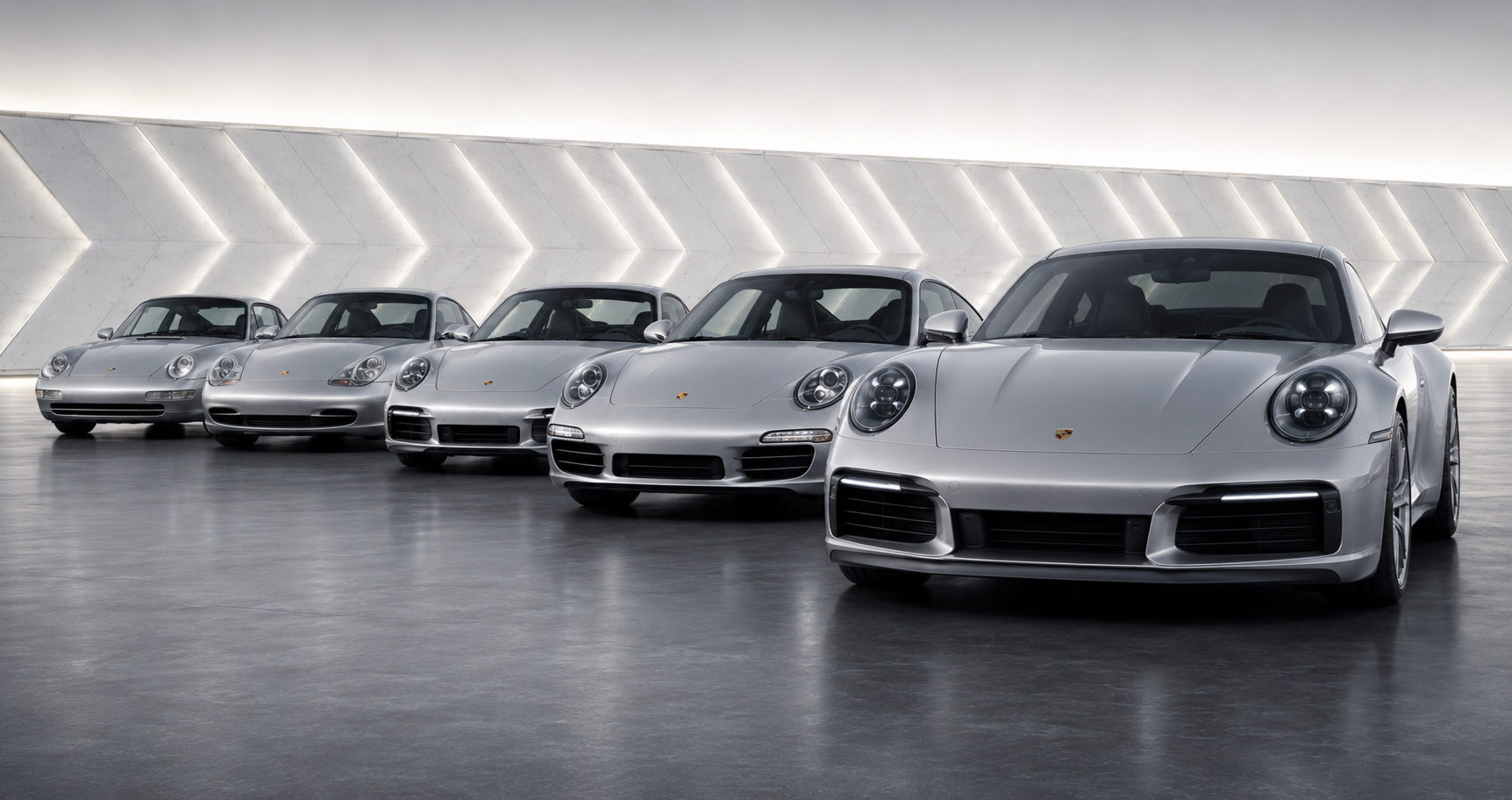
Quick history for anyone who hasn't been living in this nerd hole. The 996 is the fifth generation 911, built from 1999 to 2004. It was the first water-cooled 911, a switch from the air-cooled engines that had defined the model for thirty-five years. Porsche made the switch to meet emissions and noise regulations that were tightening fast in Europe and North America. They also did it on a tight budget, which is why the 996 shares a front end and an interior with the much-maligned 996-era Boxster. The headlights, in particular, look like fried eggs and Porsche fans have never forgiven them.
Beyond the cosmetics, the 996 inherited a new flat-six (the M96, in 3.4L and later 3.6L forms) that turned out to have two design weaknesses that became infamous. The first was the IMS, the intermediate shaft bearing, which sits inside the engine and drives the camshafts off the crankshaft. The original sealed bearing wasn't designed to be serviced; some of them failed at low mileage and took the engine with them when they did. The second was bore scoring on later 3.8L S engines, cylinder wall wear that, in extreme cases, also took the engine out. Both failures cost roughly $15,000 to fix in parts and labour, and both were unpredictable enough that the entire generation got branded as a roulette wheel.
That's the case against. The case for is that everything else about the 996 is genuinely excellent. The chassis is still recognizably the chassis of every 911 that came before and after, the rear-engine balance, the steering feel, the low cowl, the signature feedback. The 3.6L variant makes 320hp, which is plenty. Hydraulic steering. Manuals available across the lineup. The Turbo and GT3 variants used the older Mezger engine and have none of the M96 problems at all, those are just freely good cars that happen to wear the 996 body.
What actually changed
Three things, all in the last decade.
First, the IMS problem has a known fix that costs about $1,800. LN Engineering and Pelican Parts produce upgraded IMS bearings that solve the original failure. The fix is a 3-4 hour clutch-out job at a competent indie shop. Many cars have already had it done; for the cars that haven't, $1,800 plus a tank of gas is the price of immunity. The whole apocalypse scenario the forums spent twenty years narrating is now a line item.
Second, bore scoring turned out to be a much narrower problem than the panic suggested. The actual incidence rate, on the 3.4L M96 (the volume engine in the Carrera), is somewhere around 2-4% of cars over their lifetime. The cars that get it are concentrated in two patterns: long highway-only running (which doesn't get the engine through a full thermal cycle) or aggressive driving on cold oil. Neither is the typical Carrera owner. The 3.6L is more prone to it; the 3.8L S is the worst. But the average buyer is shopping a 3.4L Carrera, not a 3.8L Carrera S, and the math on a 3.4L is genuinely fine.
Third, and this is the part nobody talks about, the average 996 in the market today has already had its cooling system addressed. The water pumps, expansion tanks, hoses, and serpentine belts that were going to fail by 100,000 km have, in fact, failed and been replaced, usually 5-10 years ago. The 996s currently for sale are not 25-year-old cars on original parts. They are 25-year-old cars that have been through one or two complete refreshes, often by enthusiast owners who were aware of every common issue going in. The cars that didn't get that refresh died years ago and are no longer in the market. What's left is, on average, a meaningfully better car than the 996 the forums were arguing about in 2008.
Why the prices haven't moved (yet)
And yet, and this is the interesting part, the asking prices haven't reflected any of this. A clean, sorted, IMS-addressed 996 Carrera with a manual is currently a $36k–$48k car in Canada, depending on miles and condition. The equivalent 997.2 Carrera S is $74k–$90k. The 991.1 is $95k+. Air-cooled is its own market and effectively priced out for anyone shopping at this level.
The 996 is the only entry point to modern 911 ownership where the cost of admission is still under $50k, and within that bracket the actual cars are dramatically better than people assume. For the last five years I've watched 997.2 prices climb steadily, about $4,000-$6,000 a year on a clean Carrera S manual. The 996 has stayed flat. That's not because the 996 is a worse car than it used to be; it's because the reputational lag between "people fear this generation" and "the market revalues this generation" is long, and I am still in the lag.
Eventually that lag closes. I don't know whether it closes via 996 prices rising or via the 997 staying inflated until it forces buyers down a generation, but either way the spread compresses. My read is that I'm roughly two to three years from a meaningful 996 revaluation. If you buy at $40k now, you're holding what will probably be a $50-55k car by 2028. That's not a get-rich plan; it's a "buy a great car at the right point on its curve" plan, which is the only kind of car-as-asset plan that tends to work.
Which 996 to buy
Three rules, in priority order.
Rule 1: 3.4L Carrera, manual, mid-year. The volume Carrera with the smaller engine is the buy. The 3.6L produces more power but introduces more risk, and the 3.4L is plenty quick. Manual transmission for resale and feel; the Tiptronic is fine but takes 15-20% off resale and most enthusiast buyers won't want it next time around. Mid-year (2001-2003) is the sweet spot, the early 1999s have some quirks the 2001 facelift addressed, and the 2004s are basically 997 prep cars with shared parts that are getting harder to source.
Rule 2: IMS already addressed, with documentation. Don't buy a "the previous owner said it was done" car. Buy a "here's the invoice from LN Engineering installation in 2019, here's the bearing they removed, here's the 30k km that have run since" car. Pay a $4,000 premium for that documentation if you have to, it's exactly the cost of doing the work yourself, with zero downtime and zero risk.
Rule 3: Service binder, not service vibes. The 996s with the cleanest binders are the cars worth chasing. Ten years of receipts at the same indie shop is a green flag. Three different shops over the last five years, with gaps, is a yellow flag. No paperwork at all is a hard pass, there are too many cars in the market right now to take a flier on one with a hidden history.
If you're shopping seriously, the right 996 in Canada comes up roughly twice a quarter at the right price. If you'd like a second pair of eyes on a specific listing, book a 15-minute call — sometimes the best 996 is the one you almost passed on.
The case against me
Two reasonable objections to everything I just said.
One: the IMS fix doesn't cover the more recent dual-row IMS variant or the 3.6L cars perfectly. True. There's a smaller subset of M96 engines (specifically the late 3.6L) where the fix is more involved and not all bearings are interchangeable. If you're shopping a 3.6L, the rules tighten. The 3.4L is unambiguous.
Two: "smart money" calls have a tendency to convince you the floor is now while the floor keeps falling. Also true. I am not the first person to claim the 996 was about to revalue; the same call has been made every two or three years since 2014, and the price has stayed roughly the same in real terms the entire time. It's possible this call is wrong too. The honest version of my argument isn't "buy a 996 now because it'll appreciate", it's "buy a 996 now because the reasons people have avoided it for twenty years have largely been resolved, and you're not paying a premium for that resolution yet." Whether the asset appreciates or just stays flat, you've bought a great car at the right price. That's the floor of the argument.
I'm at peace with the 996 still being undervalued in 2030. I think it's more likely to be revalued by then. Either way, the buyer who acts on this gets a brilliant 911 in their garage at a price that won't exist for the same car in any other generation. That's the actual bet.

Founder of Carsmenskii. BMW Group Canada Aftersales 2018–2021. Started writing about 911s in 2020, started sourcing them for clients in 2026. Book a 15-min call if you'd like to discuss a specific car.