Every Canadian EV · 20 chapters · 82 pages Or have me source one for you →
Deep Dive · 20 chapters · Canada-specific

Every EV worth buying
in Canada in 2026.

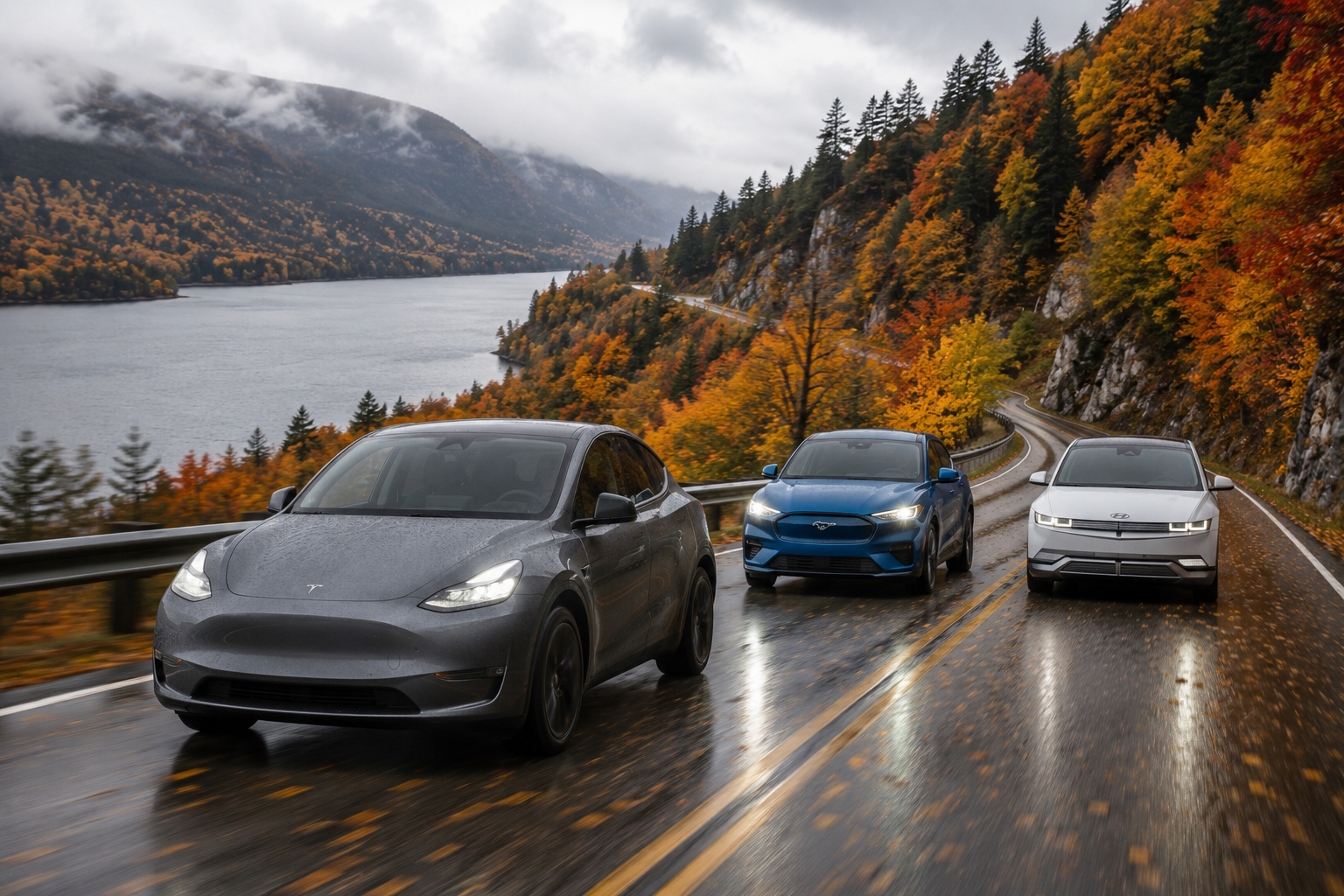
Brand by brand, from Tesla to Rivian, with battery health, real winter range, charging infrastructure by province, and provincial incentive math. Plus a short PHEV chapter and the BC-only hydrogen story. Independent, opinionated, written for buyers who want to be done second-guessing the configuration.
FormatPDF · 82 pages
CoverageEvery EV sold in Canada · 2026
ScopeBEVs · plus PHEV & FCEV addenda
Refund7-day · no questions
The Canadian EV Buyer's Bible — EVs sold in Canada in 2026
EV
20 chapters. 6 appendices. Linked Index. 82 pages.
Part II — operational reality

The Canada-specific stuff
most EV guides skip.

The cars are the easy part. The operational reality of charging an EV in Toronto in February, the apartment-charging problem, the 30-percent winter range tax, and the provincial-incentive math is where the document earns its existence.

CHAPTER 138 pages

The Canadian charging landscape

  • Tesla Supercharger / Electrify Canada / FLO / ChargePoint / Petro-Canada — by reliability and use case
  • BC vs Quebec vs Ontario vs Prairies vs Atlantic — what the public-network looks like by province
  • The apartment-dweller problem and the home-charging precondition
  • NACS / CCS transition by manufacturer for 2025–2026
CHAPTER 145 pages

Winter range realities

  • Heat pump vs resistive heat — the single biggest variable
  • The LFP cold-weather problem (Tesla RWD, most Chinese-built cars)
  • Empirical loss by temperature band, by chemistry
  • Preheating tactics that actually save range
CHAPTER 155 pages

The used-EV market

  • Why prices cratered 40–50 percent from 2023
  • Battery state-of-health verification
  • Warranty transferability by manufacturer
  • The Leaf cautionary tale
CHAPTER 163 pages

The EV-specific PPI checklist

  • Battery SoH pull, cell-balance check, charging-curve test
  • Software currency and recall completion
  • Brand-specific call-outs (ICCU, HV battery, charge-port)
  • What an EV PPI actually checks vs a generic used-car inspection
CHAPTER 174 pages

2026 Canadian incentives

  • Federal EVAP — what it is and how to claim it
  • BC, Quebec, Yukon, NWT — the strong stack programs
  • The provinces with no rebate (and why)
  • Charging-installation rebates and time-of-use rates
CHAPTER 183 pages

PHEVs in Canada

  • RAV4 Prime, Outlander PHEV, Tucson/Sportage PHEV
  • Volvo XC60/90 Recharge, BMW X5 xDrive50e
  • The right use case for a PHEV in 2026
  • Why this is a smaller chapter than it used to be
CHAPTER 192 pages

FCEVs — the hydrogen story

  • Toyota Mirai and the BC-only fuelling network
  • Why FCEV is structurally Canadian-limited
  • The Hyundai Nexo gap and what's coming
CHAPTER 203 pages

How to source one

  • The four sources: dealer, independent, private, cross-border
  • Why Quebec and BC are the strongest used markets
  • The 15-year import rule and the cross-border math
  • The broker question and when matchmaking earns its fee

Plus six appendices.

Appendix A3 pages

Glossary of EV terms

  • Every initialism that appears in the guide, in alphabetical order
  • kWh, kW, DCFC, NACS, CCS, J1772, LFP, NMC, V2L, V2H, ICCU, OBC, and the rest
Appendix B2 pages

Connector matrix & charging standards

  • Which plug fits which car
  • The 2024–2026 NACS transition by manufacturer
  • What a CCS-to-NACS adapter actually does
Appendix C2 pages

Battery chemistry quick reference

  • LFP vs NMC vs LMFP vs NCA
  • Cold-weather behaviour by chemistry
  • Charging speed, longevity, and which cars use what
Appendix D2 pages

Provincial incentive cheat sheet

  • 2026 stack by province — federal EVAP plus provincial
  • Stackable, non-stackable, used-EV eligibility
  • Charging-installation rebates by program
Appendix E3 pages

Empirical cold-weather range loss

  • Real-world range loss by car family and temperature band
  • Aggregated owner data plus Carsmenskii client logs
  • Heat pump vs resistive heat — the empirical delta
Appendix F3 pages

At-a-glance: every EV ranked

  • Every model in the document on one cheat sheet
  • Pricing (CAD) and verdict at a glance
  • Use this when you have a budget and need a shortlist
Honest disclosure

Who this is for — and who it isn't.

Buy this if…

  • You're seriously considering an EV in the next 6–12 months.
  • You want a Canada-specific source — pricing, charging, winter range, provincial incentives.
  • You're stuck between Tesla and a non-Tesla EV and want the honest comparison.
  • You're considering a used EV and want to know what to verify before buying.
  • You want one document covering every brand actually sold here, not a US guide adapted.

Skip this if…

  • You're not actually planning to buy in the next 12–18 months.
  • You only care about one specific car and don't want any context.
  • You'd rather have me source one for you (Matchmaking ).
  • You're looking for a buy-and-flip-in-six-months play (this isn't that segment).
FAQ

Common questions.

Is this Canada-specific or just adapted from a US guide?

Canada-specific from the ground up. Pricing in CAD. Provincial incentives mapped per province. Charging-network analysis for Canadian conditions. Winter range data sourced from Canadian owners. The PHEV chapter focuses on what's actually sold in Canada (RAV4 Prime, Outlander PHEV) rather than what's hot in US press.

Does it tell me which EV to buy?

It tells you which one fits your situation. Each brand chapter ends with a verdict (Strong Buy / Cautious / Skip) keyed to specific trims, plus an at-a-glance Appendix F that ranks every model in the document with pricing and verdict on one cheat sheet. If you're stuck between an Ioniq 5 LR AWD and a Tesla Model Y LR AWD, the Bible gives you the honest case for each.

Does it cover the used market?

Yes — Chapter 15 specifically, plus used-buy callouts in every brand chapter. Used Polestar 2 LR DM, used Taycan 4S, used Tesla Model 3 LR, used Audi RS e-tron GT, and used Mercedes EQS all get specific value-play treatment with current Canadian pricing.

What about charging at home — and what if I live in a condo?

Chapter 13 covers home Level 1 / Level 2 / Level 3 charging in detail, plus the apartment-and-condo problem honestly. If your building doesn't have an EV charging plan, the document tells you when EV ownership is workable as a public-charging-only setup (BC and Quebec, mostly) and when it isn't (everywhere else, mostly).

Does it cover PHEVs and hydrogen?

Yes — short chapters on each. Chapter 18 covers PHEVs (RAV4 Prime, Outlander PHEV, Tucson/Sportage PHEV, Volvo Recharge, BMW xDrive50e). Chapter 19 covers FCEVs (Toyota Mirai, the BC-only hydrogen network). The document is 90 percent BEV by content because that's where the Canadian market is in 2026.

How current is the data?

The 2026 Edition reflects MSRP, used-market pricing, and charging-network coverage observed through Q1 2026. Annual updates ship to existing owners free, lifetime. Provincial-incentive specifics change quarterly — the Carsmenskii incentives page tracks the live amounts.

Refund policy?

7-day, unconditional, no questions. Email david@carsmenskii.com with "refund" in the subject, same business day processing.

Get the Bible

EV decisions —
solved in a Saturday.

A Canadian EV purchase has more variables than an ICE one — battery chemistry, charging network, winter range, provincial incentives, used-warranty transfer. $25 to compress months of research into one weekend read.

The Canadian EV Buyer's Bible
$25 CAD · one-time
  • 82-page PDF, twenty chapters, linked Index, six appendices
  • Every brand selling EVs in Canada in 2026
  • EV-specific PPI checklist included
  • Charging-network coverage by province, empirical winter range data
  • 2026 federal + provincial incentive cheat sheet
  • Lifetime updates · 7-day refund
Buy & download instantly

Instant PDF · No account required

More from the library

If you liked this Deep Dive…